
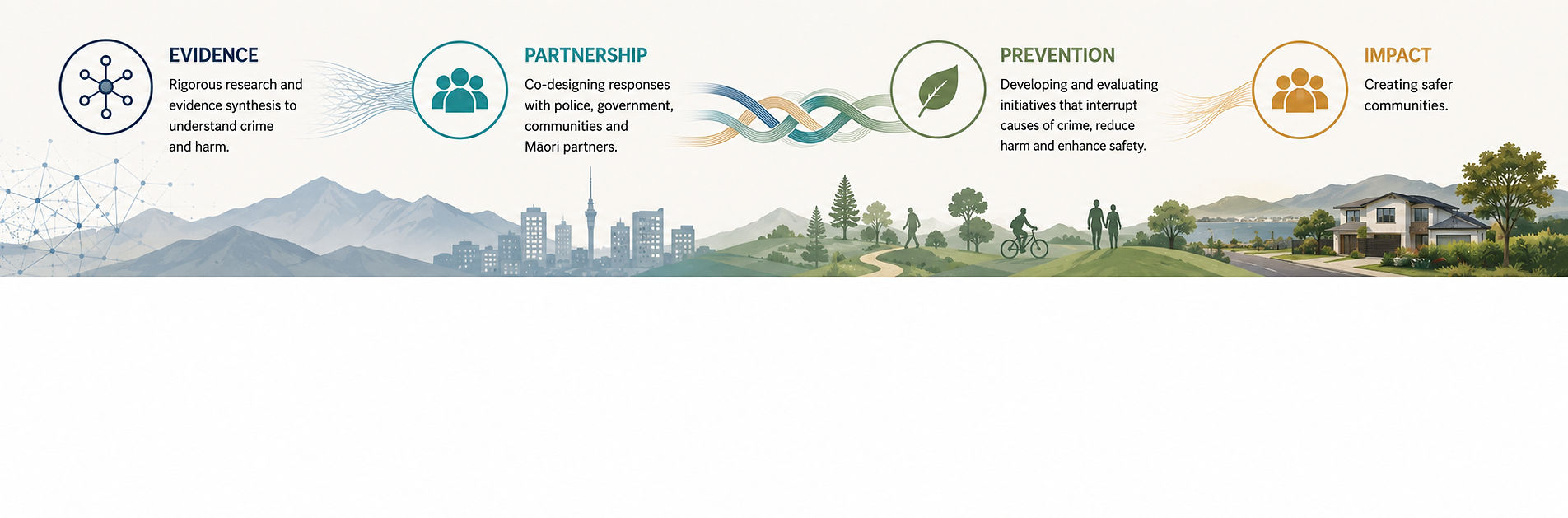
Reducing the harm caused by victimisation is the central motivation that drives my work. Good intentions are not enough though: effective prevention requires robust evidence, partnership, and a deep understanding of the contexts in which crime occurs.

My research
I work for and with crime reduction agencies to understand crime problems in depth, generate useful evidence, and develop prevention approaches that are credible, ethical, and effective. My work is grounded in crime science: the idea that crime is highly patterned, often opportunistic, and therefore preventable when we understand the conditions that allow it to occur.
Across my career, I have worked closely with police, government agencies, policymakers, practitioners, and community partners to develop new knowledge, tools, and methods for reducing crime and harm. This has included research on under-reported and hidden crimes, including waste crime, stalking, modern slavery, trafficking, exploitation, and poly-victimisation.
My research journey
My interest in crime began early. Like many teenagers growing up in the 1990s, I once thought I wanted to be a criminal profiler. That interest led me to a BA(Hons) in Criminology and Sociology at Keele University, and later to work as a temporary staff member at Kent Police during university vacations. Those early roles gave me a valuable view across policing departments and senior operational portfolios.
After graduating, I became a Police Crime Analyst, where my love of data began. The role was fascinating, but I wanted stronger tools for understanding crime and developing better prevention responses. In 2005, after a chance meeting with Professor Ron Clarke, I enrolled in the MSc in Crime Science at University College London.
That experience changed the way I thought about crime. Crime science offered a practical and intellectually compelling framework: much crime is not inevitable, but shaped by opportunity, environment, and context. In my day job, I began using problem-solving approaches such as SARA to produce more insightful analysis and to integrate crime reduction evidence into recommendations for practice.
I later joined the Jill Dando Institute of Crime Science, which became the UCL Department of Security and Crime Science. Over 15 years, I worked on a wide portfolio of research projects with police forces, government agencies, practitioners, and policymakers. This included analytical work, crime mapping, practitioner training, systematic reviews, and large-scale evaluations.
In 2020, I moved to Aotearoa New Zealand to help advance security and crime science research and build a new community of crime scientists. My current work focuses on developing a crime science that is useful, inclusive, locally grounded, and capable of reducing harm in ways that are fair and sustainable.

My research
My interest in crime began early. Like many teenagers growing up in the 1990s, I once thought I wanted to be a criminal profiler. That interest led me to a BA(Hons) in Criminology and Sociology at Keele University, and later to work as a temporary staff member at Kent Police during university vacations. Those early roles gave me a valuable view across policing departments and senior operational portfolios.

Contact me
Te Puna Haumaru Centre for Security and Crime Science, University of Waikato, Hamilton, New Zealand.
About me